Character: The Old Testament Law was Israel's first glimpse of God's character and how to live as His people. The Law provides guidelines for discipline and personal holiness.
READ: Deuteronomy 6 What can you learn about God's will for His people in this chapter?
Do we want good children or godly children? This question lies at the heart of our true desire for our children.
In the midst of a secular society, it is easy to leave God out of the training of our children. For any child to be a "good" child he must be raised by God's truth, even if the parents do not acknowledge they are doing so. They enjoy His world, His gifts such as life and bodies but do not give any thanks to Him. This is the mark of the secular state that asserts it can run on its own.
We want godly children who know the principles of good living but also who know God Himself. We desire for our children to have a love and passion for God that overflows in a love for mankind. Without Jesus Christ our ability to forgive, have compassion and to love is greatly limited. In Christ we have the ability to have Christ live His life in us.
Our goals for our children must go far beyond what we can do in our own strength, which only feeds our pride. We must train our children to trust God and live a supernatural life in which they walk in His Spirit. There are many voices telling us how to parent, but the majority of them reject God's purpose for our children. Because many Christian families have bought into secular thinking, their children are living as immorally as the society around them.
Now is the time to change the course of history through our own families. God can do great and mighty things through a small number of families that live by His great and glorious promises and purposes. In this session, we will first focus on God's principles for raising our children from Deuteronomy 6 and later conclude by mentioning some practical points on how we can implement these life-changing principles.Principle #1: Establish and live by God's standards (Deuteronomy 6:1)
Now this is the commandment, the statutes and the judgments which the LORD your God has commanded me to teach you, that you might do them in the land where you are going over to possess it. (Deuteronomy 6:1)
In the chapter before this, the Ten Commandments were clearly given to the people again. God is holy; therefore we must do things His way in order to please Him. Therefore, we must know what the Lord says and then actually obey Him by doing just what He says. Moses taught the Israelites God's commands in order help them live out godly lives among the heathen nations. Our standards must come from God's standards. As these commands have been taught to us, we need to teach them to others.
Principle #2: Pass it on to next generations (Deuteronomy 6:2)
So that you and your son and your grandson might fear the LORD your God, to keep all His statutes and His commandments, which I command you, all the days of your life, and that your days may be prolonged. (Deuteronomy 6:2)
God wants us to think in terms of generations. We are not only to think of our children but our children' s children. The 'you,' 'your sons,' and 'your grandson' reflect three generations. What we do with our lives greatly impacts the lives of the next generations. The 'fear of the LORD' is the conscious presence of God, which influences our lives. Many people live their daily life as if God has nothing to say about how they should live.
When God's Word has minimum impact on what a person does, we can say he is secularized even though he might be religious. The ' fear of God' is no longer in his life. Our purpose is not just to pass down the LORD's commands but that our children might fear the LORD and keep His commands. Knowledge of His commands is insufficient. Knowledge must be translated into life change.
If a generation only has knowledge of His commands and no love for His ways (this is where Christianity has degenerated into a mere religion), then the next generation will depart from those commands.
How do we avoid this generational departure? Parents must pass on the fear of the LORD to their children and children's children. The Christian parent must do everything to pass on the heart and passion for the Lord as well as knowledge of the Lord's commands.
On the positive side, if we live out godly lives before our children, they will most likely pick up that passion. We must be careful to instruct them about who the Lord is and all about His ways. Neglect of this will lead to a next generation that has respect for our ways but no power.
If we live compromising lives, then we live as if we are already in the second generational stage. Our children will, for the most part, leave the Lord. They do not believe because we do not really believe. Genuine faith always touches our life's priorities. Only a false religious faith permits a division between 'belief' and life. Our children look at the goodness of our lives rather than what we say. They are right. If we do not live by what we say, then they see only our hypocrisy. This produces sad and bitter lives.
Pause for Reflection: Are you excited about what God is doing in your life?
6.3
For a nation that had wandered 40 years in a parched wilderness, a land flowing with milk and honey sounded like paradise. It brought to mind rich crops, rushing streams, gentle rains and lush fields filled with livestock. The Israelites could have had all that 40 years earlier. Numbers 13 and 14 explain how the people missed their chance. Now Moses was determined to help the people avoid the same mistake by whetting their appetite for the beautiful land and then clearly explaining the conditions for entering the land.
Principle #3: Convinced of the need for God' s blessing (Deuteronomy 6:3)
O Israel, you should listen and be careful to do it, that it may be well with you and that you may multiply greatly, just as the LORD, the God of your fathers, has promised you, in a land flowing with milk and honey. (Deuteronomy 6:3)
God's ways always bring the greatest blessing. To the degree our lives are shaped by His teaching, we are able to live by His high standards. When we carefully apply these teachings to our lives, then we see how God's promises fill our lives. Part of this blessing is material blessing. Part of it is multiplication. God wants to increase what is good. Having many children is a blessing of our LORD, which should not be hindered.
And He will love you and bless you and multiply you; He will also bless the fruit of your womb (Deuteronomy 7:13).We will either believe our welfare is dependent upon keeping God' s Word or we will not. To the degree we obey, we will be blessed. Our goal should be to 'run' after His commands. Only in this way do we have a passionate love for God that would be worthy to transfer to the next generation.
6.4
Monotheism -- belief in only one God -- was a distinctive feature of Hebrew religion. Many ancient religions believed in many gods. But the God of Abraham, Isaac and Jacob is the God of the whole earth, the only true God. This was important insight for the nation of Israel because they were about to enter a land filled with people who believed in many gods. Both then and today, there are people who prefer to place their trust in many different values, belief systems and "gods." But the day is coming when God will be recognized as the only one. He will be the king over the whole earth (Zechariah 14:9).
Principle #4: Undivided loyalty to Yahweh (LORD) (Deuteronomy. 6:4-5)
Hear, O Israel! The LORD is our God, the LORD is one! And you shall love the LORD your God with all your heart and with all your soul and with all your might. (Deuteronomy 6:4-5)
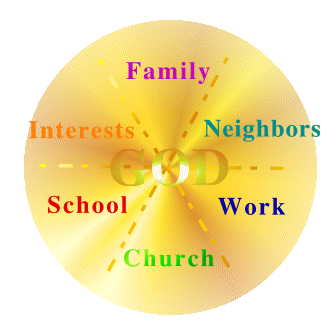 Since the Lord is one, we must not divide our affections between Him and something else. If there were several gods, then our loyalty would be divided. Since He is one, all of our devotion, inspiration and strength must be used to do all that He says. His words take a priority in our lives. God is asking, even demanding, that we take all of our work, family, and personal plans and re-work them so that He becomes the center of our lives. A doctor, for example, should give up his occupation if he is required to do abortions. He should not murder. The commitment to life requires him to help not hurt people.
Jesus told us that we could only love Him or wealth (mammon) (Matthew 6:24). If a family worships money, then their decisions will be made with those prior commitments in mind. In the end, we will only prioritize one God. We need to commit to serving the LORD Yahweh as a family. This decision sets our family apart from others. This is important to communicate to our children.
Pause for Reflection: Is God your life priority? If things got real bad like Job, would you give up God?
6:5
Jesus said that loving God with all ourselves is the first and greatest commandment (Matthew 22:37-39). This command, combined to love your neighbor (Leviticus 19:18), encompasses all the other Old Testament laws.
Principle #5: Devoted to His Word (Deuteronomy 6:6)
And these words, which I am commanding you today, shall be on your heart. Deuteronomy (6:6)
We fool ourselves if we think that we can raise our children to become godly men and women without having a passion for God and His Word ourselves. His words must be on our heart. We can judge our commitment by discerning how much time we spend keeping God' s Word fresh on our hearts and minds. When we do spend time in His Word, is it because we desire His Word or because we are obligated to. We do go through ups and downs in our spiritual life, but the real test is how much we really love God through all those times.
Pause for Reflection: How many times do you as the father meditate on God's Word through the week?
6:7
The Hebrews were extremely successful at making religion an internal part of life. The reason for their success was that religious education was life-oriented, no information-oriented. They used the context of daily life to teach about God. The key to teaching your children to love God is stated simply and clearly in these verses. If you want your children to follow God, you must make God a part of your everyday experiences. You must teach your children diligently to see God in all aspects of life, not just those that are church related.
Principle #6: Display God' s Word (Deuteronomy 6:8-9)
And you shall bind them as a sign on your hand and they shall be as frontals on your forehead. And you shall write them on the doorposts of your house and on your gates. (Deuteronomy 6:8-9)
We surround ourselves with what we love. If we love God's Word then it will be all around us. We can put scripture on our computer screens, walls, plaques, etc. We should throw away some of those old items that show our old treasures and replace them with our growing love of God's Word. Throw away those Buddha statues and anything else associated with different religions. Take down those pictures of movie and sports idols. If pictures are depressing, replace them with one from Psalm 23. More than this memorize these verses with your children and learn to treasure them.
The best place to store God's Word is in our heart. What is on our walls should only reflect what is in our hearts. We put scripture about our home not because it is mandatory but because that is what we like.
Pause for Reflection: What do you decorate your walls with? Would anyone know that you have a great love for God from walking in or around your home?
6:4-9
This passage provides the central theme of Deuteronomy. It sets a pattern that helps us relate the Word of God to our daily lives. We are to love God, think constantly about his commandments to our children, and live each day by guidelines in his Word. God emphasized the importance of parents teaching the Bible to their children. The church and Christian schools cannot be used to escape from this responsibility. The Bible provides so many opportunities for object lessons and practical teaching that it would a shame to study is it only one day a week. Eternal truths are most effectively learned in the loving environment of a God-fearing home.
6:10-13
Moses warned the people not to forget God when they entered the Promised Land and became prosperous. Prosperity, more than poverty, can dull our spiritual vision because it tends to make us self-sufficient and eager to acquire still more of everything -- except God. The same thing can happen in our church. Once we become successful in terms of numbers, programs, and buildings, we can easily become self-sufficient and less sensitive to our need for God. This leads us to concentrate on self-preservation rather than thankfulness and service to God.
6:24
Does the phrase "so he can continue to bless us and preserve our lives" mean that we can expect only good things and no suffering when we obey God? What is promised here is a right relationship with God for all those who love him with all their heart. It speaks of a good relationship with God and ultimate benefit of knowing him. It is not blanket protection against poverty, adversity or suffering. We can have this right relationship with God by obeying his command to love him with all that we are.
REFLECT: How do you live out verse 5 on a daily basis?
I try and offer thanks for everything good or bad that happens on a daily basis. When I need to pray for someone; I do so right there and then. I make sacrifices for God to show him my love by not doing worldly things! And I just love people the way God loves me!
RESPOND: What is something in this chapter that you can take on as a personal challenge to do?
"You must diligently obey the commands of the Lord your God--all the laws and decrees he has given you." Deuteronomy 6:17 As a human... I sin everyday and therefore should fully repent these sins everyday. Which means getting my mind and heart right before starting everyday so that I can be aware that I am indeed sinning!


No comments:
Post a Comment